

Created on:
Modified on :
The power of AI and automation serving profitability: the example of Industry 4.0

Written by :
Aline
Beyond the somewhat "gadgety" or political representations one might have of it, Industry 4.0 represents a set of measures that deeply modify the production processes of industrial companies: they perfectly illustrate the concrete contributions that digital tools such as AI and automation can represent for companies.
Here's the opportunity to learn more about the subject, or to discover the real stakes of industry in 2025 and the essential role of digital! We'll also take the opportunity to check where French companies stand in terms of automation and digitalization.
Connected factory: what does Industry 4.0 mean exactly?
To start, what does this expression "Industry 4.0" mean exactly, and where does it come from? Let's start with a bit of history to better understand the evolutions of the industrial sector, because Industry 4.0 simply means that we are at the 4th Industrial Revolution:
- The 1st Industrial Revolution took place at the end of the 18th century with the invention of the steam engine, which provided a much more efficient source of energy in agriculture and production, and enabled the emergence of the first factories. Industry appeared and gradually replaced craftsmanship or production in workshops.
- About a century later, the 2nd Industrial Revolution accelerated production thanks to machine tools: its most famous symbol is the Ford T with the arrival of assembly lines and mass production.
- In the 1950s, electronics and IT further relieved factory work with the programming and automation of repetitive tasks: this is the 3rd Industrial Revolution.
- The 4th Industrial Revolution with the notion of Industry 4.0 appeared in 2011 in Germany at the Hanover fair. After the emergence of machines, mass production, and automation, this revolution introduces the notion of mastery at all levels of production: how to produce in a personalized way while being profitable, with optimal use of resources?
To sum up, in industry 4.0, machines become "intelligent" in order to self-regulate thanks to AI and real-time analysis of data collected during production processes. That's why it is also called "Smart Production".
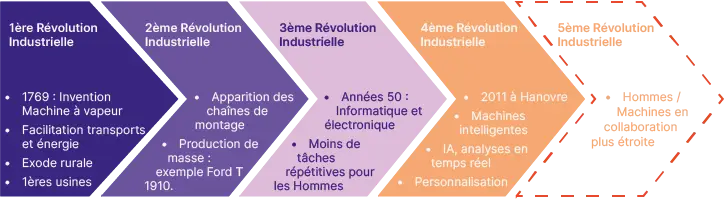
By the way, people are already starting to talk about Industry 5.0... Which heralds a closer Human/Machine "collaboration" with the return of humans at the center of the most strategic decisions or those requiring more creativity and emotions.
What are the stakes of the Factory of the future?
Production processes are concerned at all levels by Industry 4.0, and digital brings many advantages:
Greater flexibility
Companies have greater mastery of their production and their resources. The objective is to avoid waste, while adapting more easily to consumer demands and personalizing their customer experience as much as possible.
Robotization including AI enables this flexibility and a higher degree of customization. There is also a lot to say regarding AI: while waiting for a detailed article on the subject, our AI page already explains a few notions to you! 😉
Time savings and productivity
The automation of certain repetitive tasks, including on the administrative side, makes it possible to avoid omissions and errors, and favors higher-added-value missions carried out by humans in the production process: this can go through the use of certain software at every level of production.
Increased anticipation
The Internet of Things (IoT) makes it possible in particular to reduce breakdowns and downtime, which are often costly for the company: thanks to real-time data analysis via sensors placed on the machines and predictive AIs. Yes, AI is everywhere! 😊
Economic advantages
Thanks to time savings and production optimization, companies using innovative digital solutions see quickly measurable financial gains:
- an ROI measured from 6 months by large companies,
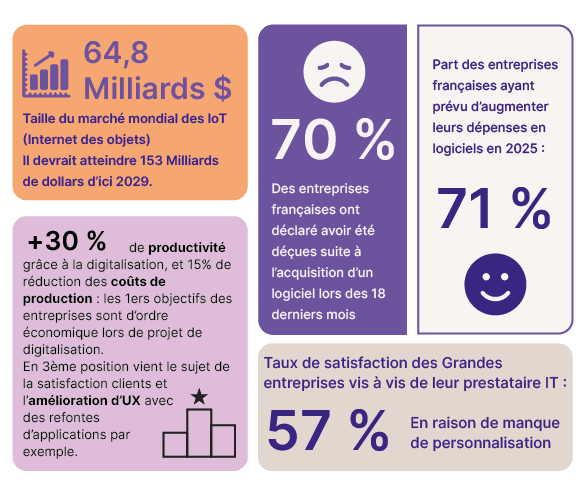
- +30% productivity
- up to 15% reduction in production costs in certain industries.
Where do French companies stand in their digitalization?
Widely adopted deployment of new tools
Since 2011, the date when the notion of Industry 4.0 first appeared, companies have come a long way in their digitalization, with certain sectors such as Automotive, Aeronautics, and Pharmacy at the forefront.
Today, 64% of French industrial companies have digital tools aimed at improving their production processes via automation and AI.
While the stakes for French companies are strategic in terms of productivity and international competitiveness, the topic of digitalization is also promising for many companies and tech start-ups.
Technologies such as the development of software promoting task automation, and tools integrating AI, are seeing growing demand. For example, the IoT (Internet of Things), which allows real-time production analyses with sensors connected to machines and predictive AI, today represents a market of €64.8 billion and is expected to continue its growth to reach $153 billion by 2029.
Strong disparities between small and large companies
Even though the largest groups are equipped today, only 45% of French SMEs have a clear digital strategy in 2024, which demonstrates great disparities in digital maturity according to company sizes.
In terms of objectives, economic gains are the most cited in digital investment projects: managers hope for either productivity gains, or better control of production costs.
This priority is cited by 68% of managers of large groups, and in 82% of cases in the construction and public works sector.
Next comes the demand for adaptation to new trends and customer usages, for 60% of companies in the Retail and Household Services sectors: we then find more projects linked to web or mobile applications.
However, these expected gain objectives are much more present within large groups, while smaller companies focus more on expenditures:
- Micro-businesses and small SMEs invest less quickly, and when they do, they are rather concerned by the cost of the projects and tend less to measure their profitability. As long as their costs are under control, they declare themselves very satisfied with their IT providers, at 84%.
- Large companies are more offensive and invest with a view to productivity gains thanks to process automation. They declare themselves however less satisfied with their IT providers, with a satisfaction rate of 57%, related to a lack of customization of the solutions offered to them.
What are the main decision factors for companies?
While the majority of companies intend to intensify their software spending in 2025, 70% have also indicated their disappointment following the acquisition of software over the previous 18 months.
So what are the criteria used by managers to guide their choice and make the decision to invest in their digital strategy?
- The integration of new tools into existing infrastructures: taking into account the existing environment within the company naturally facilitates the adoption of new tools as well as their efficiency and profitability.
- Data management: AI and the Internet of Things require a lot of data in order to be effective in their analyses, and also generate a significant data flow. This data must be secured and often comply with regulations, such as GDPR.
- Adaptation to the specific needs of companies: a custom-made tool will naturally be more adapted to the issues and constraints of the company, and will also elicit better buy-in from employees.
- Investment costs are the primary obstacle, with significant disparities depending on the size of companies: large companies are much more offensive in investments aimed at productivity gains and improving the UX of their customers, while smaller SMEs are especially attentive to the costs of projects.
Although spending on this type of tool generates a rapid ROI with very concrete gains for companies, the smallest of them may be all the more held back by the financial aspect: there are however many financing schemes depending on projects and regions, and it may be worth taking a look rather than missing out on great developments!
Recent technologies, such as Low Code, also enable easier access to the development of high-performance and custom-made digital tools: that's our specialty, and we talk to you about it 👉 here!
Sources:
- bigmedia.bpifrance.fr
- Xerfi
- Rapport Tech Trends 2025 Capterra
- francenum.gouv
Ready to reap the benefits of a tailor-made digital solution, built 4x faster, 3x cheaper, 12x more profitable


