
Created on:
Modified on :
Agile: a powerful asset for successful projects
What is Agile?
We're used to hearing that Agile is a project management method, but it's not that simple. Agile, if we're only talking about it, is a manifesto that provides values and principles to be respected; it's a culture to embrace.
Before diving in, a bit of history. You won't hold it against me, I hope 😅. This will allow us to understand why Agile came about and we'll better understand its application. 😎
The birth of Agile
It all starts, or almost, with a group of developers who, in the early 2000s, came together with one goal in mind: How can we make the software development process more effective?
Why did they do this? They had all encountered the same issues in so-called "traditional" or "Waterfall" development methods:
-Development time too long compared to the ultra-fast pace at which the market evolves.
-A lack of flexibility in relation to the changing needs of clients.
-A lack of visibility for the client on the development of THEIR product.
What resulted? Clients frustrated at having a solution that didn't match their expectations, and often behind the market, which had continued to grow.
Faced with these challenges, a group of developers decided to get together during a ski weekend. Yes, you read that right, a ski weekend 😄! They took the time to think together about a solution while enjoying the snow and good times; you have to know how to combine the useful with the pleasant 😉! It was in this setting that the Agile Manifesto was born, a founding document that defines the principles of Agile. This manifesto has continued to evolve and grow richer over the years, adapting to new challenges as they arise.
Agile VS Waterfall
To better understand the stakes in practice, let's come back a little to the differences between Agile and Waterfall.
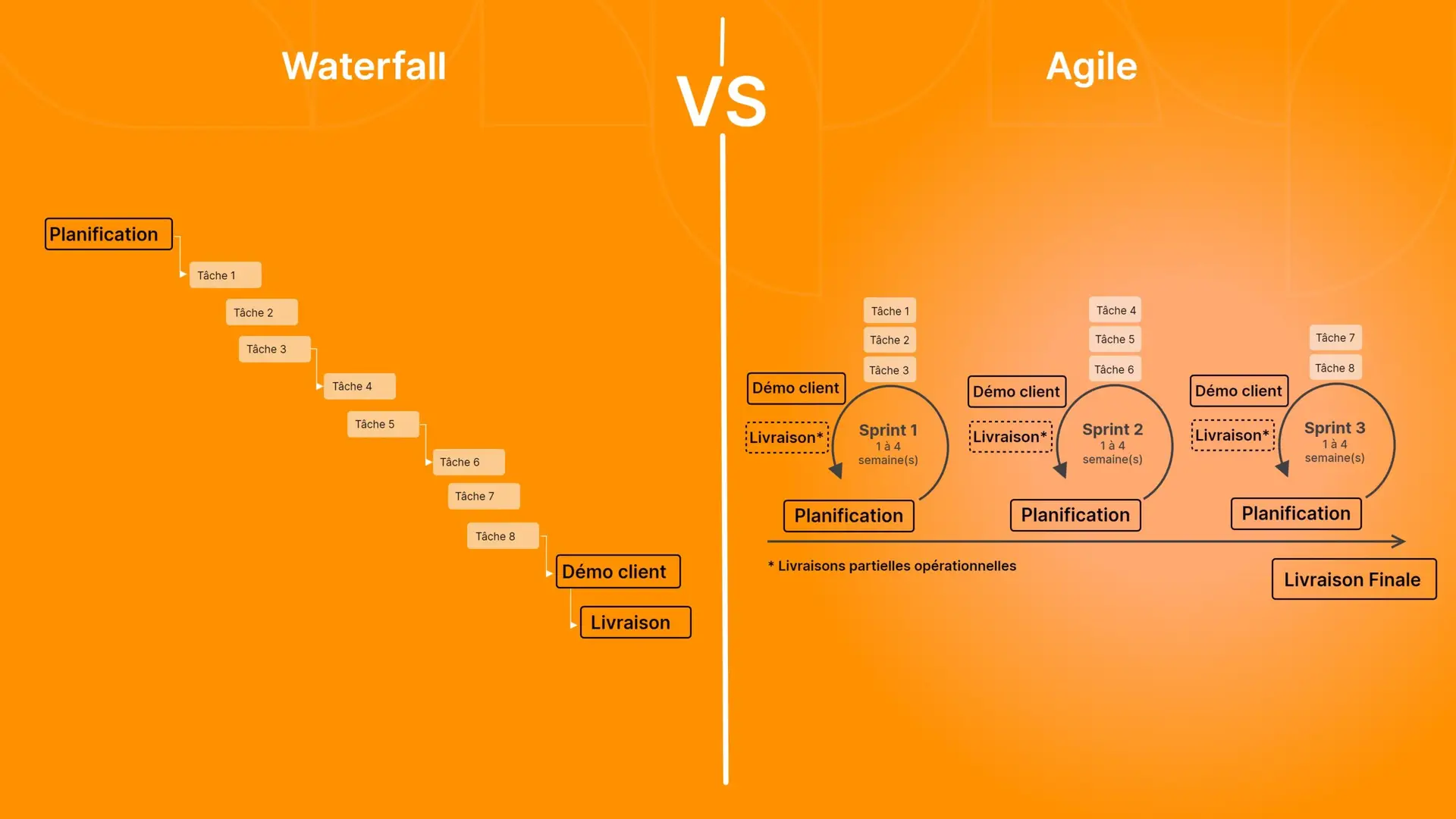
How Waterfall management works
The more classic management method is also called Waterfall because tasks are managed in a cascade, that is one after the other. This older management method unfolds as follows:
- Discovery of client needs
- Drafting of the specifications
- Estimation of the schedule and budget
- Start of development
- Implementation of tests – acceptance testing
- Project deployment
- Maintenance to correct any bugs.
This proven method has a very reassuring side in that the finished product is clearly described, and likewise the timelines and costs are estimated according to a result-based objective.
In practice, its strict structure and its organization in "stages" of tasks can lead to a lack of flexibility, which is particularly problematic when it comes to IT or web projects. In these trades, the market environment tends to evolve so rapidly that having a precise picture of the finished project in advance is not an advantage!
Let's take an example to illustrate these issues:
Imagine an application development project! Following the validation of the specifications and the budget with a development agency, production is launched! A year later, the client finally receives their product...
And the disappointment is great. The product delivered does not match what they had imagined. But why? With only a specification document as a guide, the developers couldn't grasp every little detail, every precise expectation of the client. During this year, the market needs evolved at a lightning-fast pace, making the product partially or even completely obsolete. And the client had very little visibility into the progress of the "works". Furthermore, the lack of flexibility in the process would have prevented any adaptation along the way to the client's changing needs.
What improvements does Agile bring?
To compensate for the lack of flexibility and responsiveness, project management in an Agile framework is organized around "sprints" or iterations of about 1 or 2 weeks that break down the development phase. Each sprint contains priority features to be developed, defined with the client at the end of the previous one.
This management allows:
- To develop features independently from each other, unlike Waterfall, which requires that a task be completed before another can be started;
- To deliver at the end of each sprint a functional product, even if it is not yet complete, so that the client can test progress in real time;
- To be able to modify priorities or integrate new features into the desired product during development, without waiting until the very end for the client to realize what suits them or not.
The advantages of Agile
To schematize, the advantages of Agile compared to Waterfall can be summarized as below:
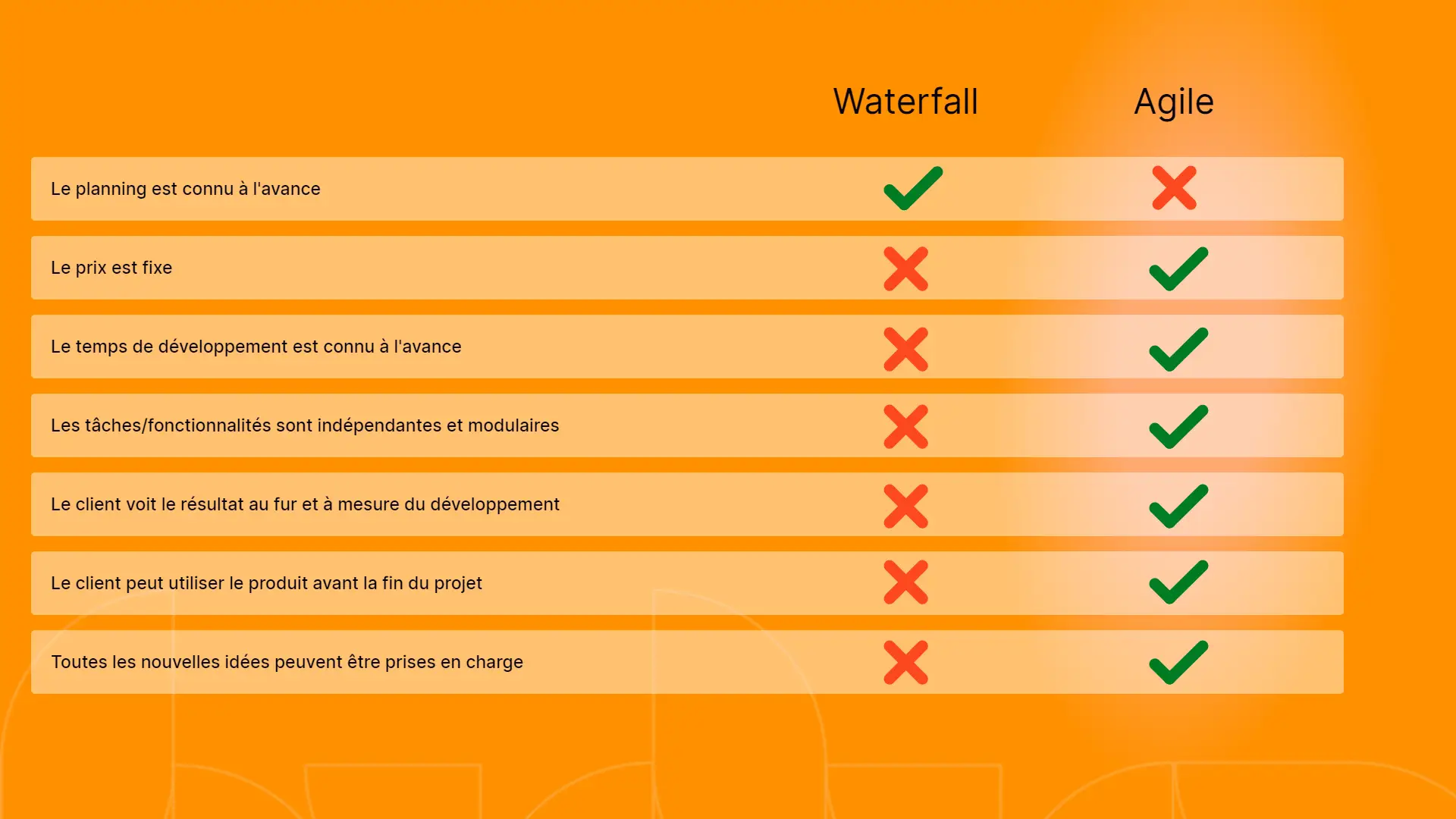
In order to be perfectly clear, 3 clarifications to complete the diagram:
- In Agile, there is still planning:
- At the start of the project, the features to be developed are estimated and ranked by order of priority with the client. The provider offers accordingly a number of sprints to develop them.
- Before each sprint, the provider reviews with the client the features to be included in said sprint: are they still the same, and have the priorities changed?
- The price is fixed for each sprint, as well as its duration, between 1 and 4 weeks depending on the complexity of the projects.
- The development time is known from the start, of course. If the client adds or modifies features along the way:
- We review the priorities with them in order to redefine the scope of the project and avoid any budget increases.
- If however the client wishes to integrate all the initial features as well as the new ones, it is possible to review the number of sprints upward.
To illustrate these differences by taking a concrete example, let's imagine this time a video game creation project!
Instead of planning everything all at once, you divide the project into small iterative steps called "sprints". To start, you develop a basic prototype of the game with a single level and basic features. At each sprint, you add new features and new levels based on tester feedback.
At each end of sprint, a new version of the game is delivered to test the new features and give feedback. This iterative and collaborative approach makes it possible to adapt quickly to players' needs and preferences. No need to plan everything from the start, because the development can adjust as you go, responding directly to tester feedback.
Agile between practice and theory
How Agile works
To summarize, Agile is a work philosophy whose outlines are defined in the 2001 manifesto.
To facilitate its operational implementation, frameworks derive from it. Among the best known, we find SCRUM, KANBAN, XP, and SCRUMBAN. These Frameworks allow teams to work in a more flexible and collaborative way, while continuously adapting to the changing needs of the market and clients. 🤸♂️
Whatever the Framework used, the objective is to respect 4 fundamental values of Agile:
- "Individuals and interactions over processes and tools": The emphasis is placed on human relationships and communication, rather than on rigid rules and tools.
- "Working software over comprehensive documentation": Rather than spending months writing detailed documents, Agile favors the creation of functional and usable software as soon as possible.
- "Customer collaboration over contract negotiation": Involving the client at every stage of the project ensures that the real needs are well understood and taken into account.
- "Responding to change over following a plan": Rather than clinging to an initial plan, Agile encourages adapting to changes and the unforeseen.
The objective is to have a framework that promotes flexibility, adaptability, and collaboration. It's a way of working that allows concrete results to be obtained more quickly and to respond effectively to changing needs.
The principles of Agile
From these four fundamental values flow 12 principles followed by the adepts of the Agile Manifesto. We are not going to list them all for you because we prefer to try to choose those that speak to us most at JUNR! Even though it was difficult to make a choice, here are the 4 that got the most votes:
"Our highest priority is to satisfy the customer through early and continuous delivery of valuable software."
"Welcome changing requirements, even late in development. Agile processes
harness change for the customer's competitive advantage."
"Build projects around motivated individuals. Give them the environment and support they need, and trust them to get the job done."
"At regular intervals, the team reflects on how to become more effective, then tunes and adjusts its behavior accordingly."
For the complete 12 principles, you can follow this link!
The application of Agile in contemporary companies
While many companies claim to be Agile, it seemed important to us to warn about the limits that may arise!
Unfortunately, some companies, particularly among the largest, define themselves as Agile for an image objective, rather than for a real objective of improving the project management process. Thus we end up with a poor implementation of Agile and the flip side of the coin appears.
Agile applied half-heartedly can be harmful for teams and give an unflattering image to clients, so here are a few clues to spot the red flags!
When a company decides to switch to Agile, its organization really needs to be modified, particularly in terms of management, to reap the benefits. Leaders must in particular be ready to:
- Exercise their negotiating power less
- Reduce their ability to control teams
- Give up their power of validation
In the all too frequent cases of very partial integration of Agile, the negative effects are felt directly: multiplication of meetings, loss of team autonomy, decrease in team confidence, and drop in productivity.
In practice, we often encounter leaders who think they see their interest in implementing Agile practices in order to put pressure on teams in terms of deadlines, without taking into account the other principles of the manifesto. However, the half-measure leads to the opposite of the advantages of Agile and to customer dissatisfaction: it is essential for companies wishing to experience an Agile way of working to be supported by experts in the field, and to respect its overall philosophy!
Conclusion
Agile is based on rapid iterations and close collaboration with stakeholders. This framework enables concrete results quickly and strong adaptation to changes and client feedback as they arise. In the end, the final product obtained better matches user expectations and can evolve with the needs of the market 🚀
There are however risks of drifts when companies only implement it partially, notably in order to try to reap the benefits of the responsiveness required, but without allowing the autonomy or the collaboration between developer teams/clients to operate! Which leads to dissatisfaction both internally and on the part of clients.
To help with its operational deployment, there are different Frameworks underlying Agile, which make it possible to adapt as well as possible to each organization!
At JUNR it was natural for us to turn to Agile, which is aligned with our vision and our values in terms of overall company and management organization! And on the technical side, this framework allows us to respect the modularity we want in all our projects: developing each feature independently of the others and delivering scalable digital tools to clients truly at the center of the projects! In addition, Agile's responsiveness is enhanced thanks to Low Code technology: enough to generate maximum profitability and performance! And if you want to learn more about this recent technology, still quite little known, it's this way!
And you? Are you ready to join the Agile team? 😎
Ready to reap the benefits of a tailor-made digital solution, built 4x faster, 3x cheaper, 12x more profitable


