
Created on:
Modified on :
Low code, no code... All the info to see things more clearly !
Traditional development: a bit of context
From binary code to programming languages
Before talking about low code, it's important to understand how the applications, software, websites... that we see today are created. What's hidden behind them... are 0s and 1s 😐. Not very fun, I'll give you that, but it's indeed combinations of these digits that make it possible to create what we know today. A name, which you've probably heard of, has been given to this language of 0s and 1s: binary.
Fortunately, today we no longer write 0s and 1s in sequence to create our solutions. Since binary was created, development has been made easier through programming languages (e.g., JavaScript, C++, Python...). These languages allow developers to indicate in a coded way the actions to be performed by the computer. There are about 2,500 of them today, but some are much more widely used than others, depending on their particularities. To get an overview, there are rankings, for example on TIOBE.
The limits of traditional code
We can say we've pretty much covered so-called traditional development, and we've reached a point where 2 constraints are difficult to overcome:
1. Development time
That's right, building everything takes time and that's perfectly normal! However, projects often take months, and can give clients the impression of never ending... So much so that by the end, the product may no longer be quite up to date if the market or needs have undergone rapid changes in the meantime.
Regarding this last point, a small aside that's close to our hearts! Thanks to an AGILE framework, project management is more flexible and allows developers to adapt to changes in priorities during the work. Essential in our eyes, especially in the digital world! More info on Agile, right this way 👉!
2. The cost of traditional development
First of all, because of the development time explained above, since billing is often done based on time spent. In short, custom-made has a cost, we could summarize! That's true, and even more so when there's higher demand than supply on the market...
And that's the case for developers right now, because development needs are found at all levels in our daily lives: all mobile applications, web platforms, and websites... Not to mention the professional world with software, automations, AI, etc...
It's in this context of high demand, rather long timelines, and high development costs that alternative solutions have emerged.
No code and its main strengths
Instead of creating yet another programming language, it's the technology that was questioned this time around.
In No Code, as the name suggests, it's no longer about entering a single line of code; it's the usage that is completely modified.
No code tools come in the form of "builders" that allow you to build sites or applications by drag-and-dropping pre-built components. Among the oldest, we can cite the example of Wix for creating your website, without any particular development experience.
Ease of use and speed of execution
Without any knowledge and in a rather instinctive way, one can manage to create a site with a pleasant design.
Affordable pricing
Since no code tools are designed for non-developers, often in the form of a software subscription, their pricing is much lower than hiring a developer. Beware, however, of announcement effects indicating free services: very often, you have to pay for the slightest option, and the total can turn out to be much more expensive than it seems!
But then, if it's simple and cheap, why bother learning to code, you may ask??? You can see where I'm going: nothing is ever that idyllic...
The limits of no code
Non-exhaustive features
With no code, there's no more custom-made work! That's its main flaw: no code limits its user to what the tool has anticipated, whereas traditional development allows for unlimited creativity and original features.
Watch out for hidden costs!
As is often the case with low-cost or even free services, you have to be wary of hidden costs: of course, it's normal for a publisher to earn revenue from their work, which is why the billing initially proposed varies according to different options or features to be activated.
Similarly, since the tool limits possibilities, you can quickly be led to add other solutions to make up for the gaps, which overall gives a result not as cheap as expected!
To summarize, we therefore have:
- on one hand, traditional code which allows for great creativity, but requires time and budget
- and on the other, no code which gives non-developers the opportunity to simply and cheaply create digital tools, but with very limited features and customization.
Wouldn't there be a 3rd possibility? 😉
Low code as an alternative
Here we are at the heart of our subject! So what is low code, and above all, what sets it apart from traditional code and no code?
Definition
Before talking about the definition, you need to understand where this word comes from. "Low" means "bas" in French, which amounts to saying "less code". Just like "no-code", which literally means "non-code", "no code". But you'd already guessed that, because you're too good at English 😉
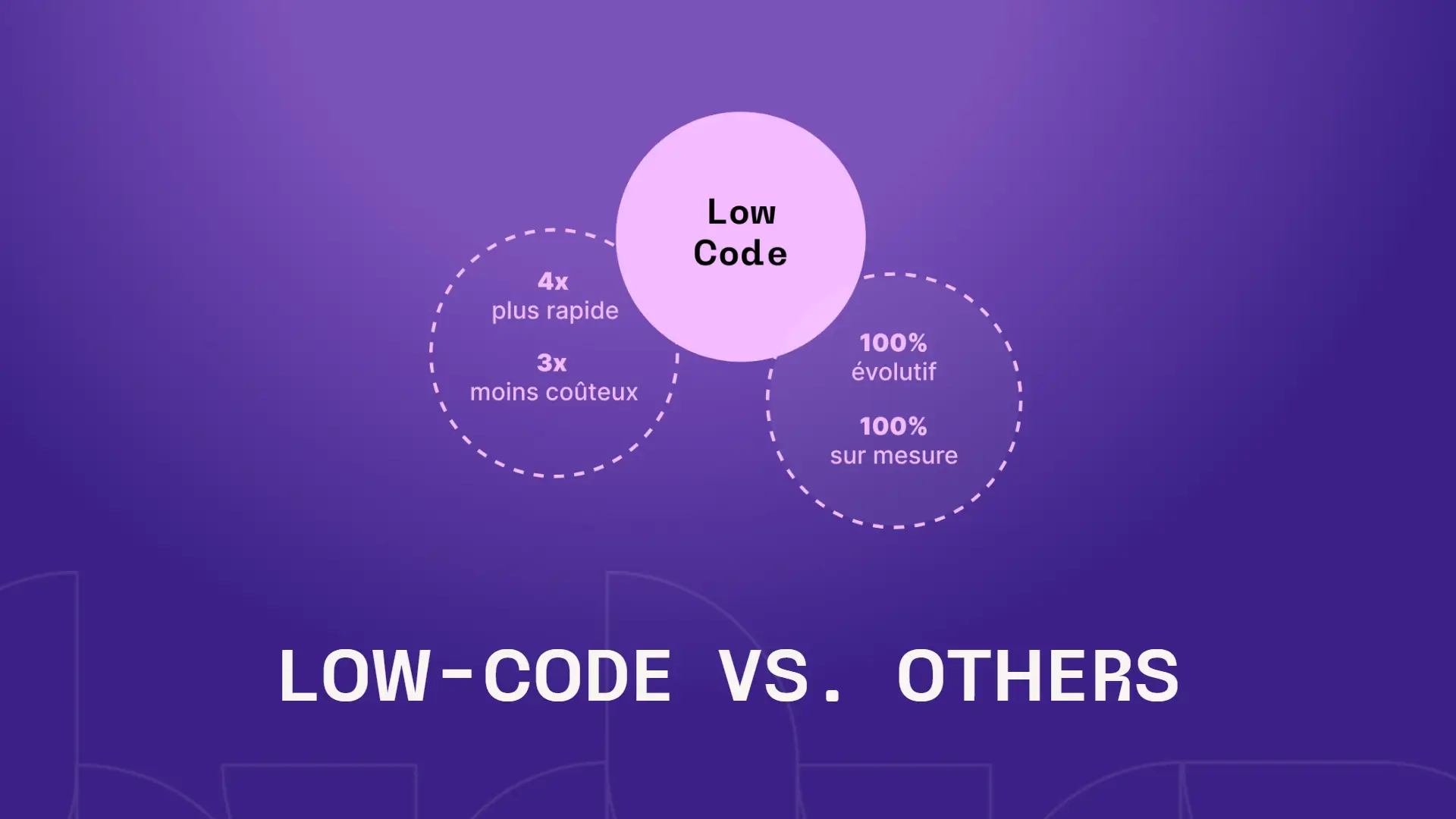
To put it simply, the goal of low code is to take the best of traditional development, that is, its unlimited customization capability, as well as the best of no code, so its speed gains and costs significantly lower than those of traditional development.
How does it work?
Like no code, low code works with a builder, that is, software that includes a visual interface allowing you to drag elements, create dynamic features, etc. However, if a specific feature doesn't exist in the builder, it's simple: the developer has the choice to write lines of code wherever they want to complement and customize everything. That's why we summarize Low Code as: the best of both worlds (traditional development and no code)!
The advantages of low code
1. Time savings
The builder-type system borrowed from no code allows developers to save time on the baseline of the work to be done.
2. Customization capability
The difference with no code is that low code interfaces allow code to be integrated in order to develop all imaginable features and customizations.
3. Cost reduction
Careful, as I like to remind: low code ≠ low cost! Cost reduction is a direct consequence of reducing the time spent developing, but in no way a degradation of value.
How to choose between traditional development, no code, and low code?
To conclude, I already hope things are clearer after these few explanations, because that's indeed our main objective: to make digital simpler and more accessible!
The questions that help
There's no ready-made answer, however there are good questions to ask yourself! As before any project, it's always good to remember the fundamentals: WHY do I need this tool? What do I expect from it? What are the real objectives behind the project?
Let's take as an example a case that speaks to everyone: creating a website.
Here are a few questions to ask yourself in order to determine which technique will be most appropriate:
- Question 1: showcase site, or e-commerce site?
- Question 2: for a showcase site, what do we expect from it?
- Question 3: How do our customers usually know about our existence? Are we hoping for more customers thanks to the site?
- Question 4: Is an omnichannel digital strategy already in place?
- Question 5: Are newsletter sends planned?
- Question 6: Is a blog section to be considered?
- ....
Of course, the list is far from exhaustive! And for each answer, ask yourself WHY again in order to uncover all the features that will be necessary for a successful project!
It's only in this way that we get to determine the real stakes behind an: "I'd just like a very simple site". And it also allows you to sort through providers: good support inevitably requires asking questions!
Knowing how to analyze the advantages of each solution
Depending on the answers, one can well imagine that no code development would be sufficient.
But in many cases, its limits are a bit too restrictive to take into account all the needs that actually lie behind a site: no code will make it possible to obtain a proper front quickly and at low cost.
However, it will have to be supplemented with other tools as well as manipulations on the client's side in order to properly manage related features, such as dynamic content.
On the other hand, development in traditional code or in low code will make it possible to obtain all the desired features: the choice will depend on the desired timeline as well as the budget, because for an equivalent project, Low code is faster and more economical than traditional development!
We can summarize and simplify the characteristics and advantages of each technique as follows:
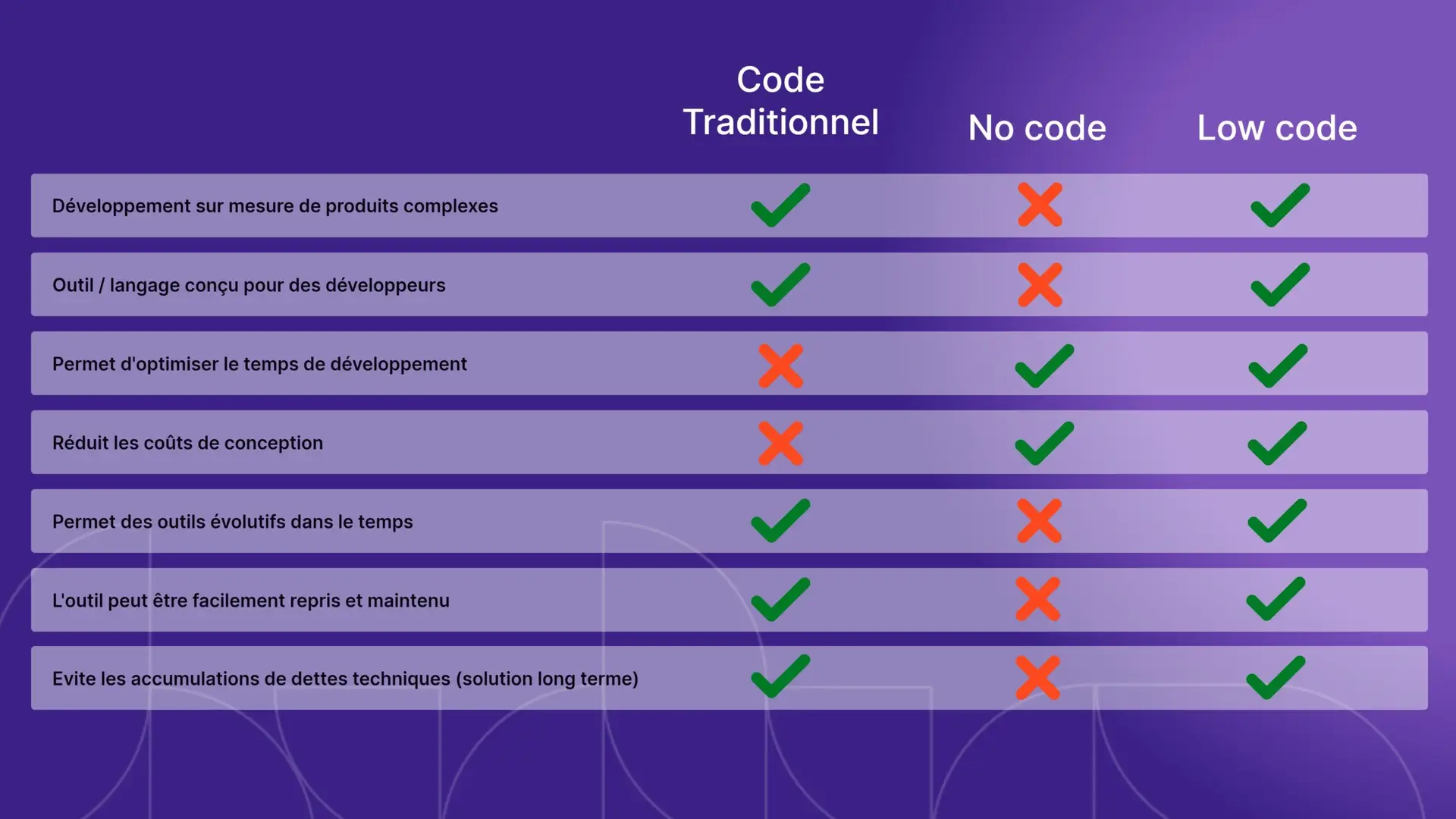
To sum up, low code is a coding technique at the crossroads of traditional code and no-code, taking on their respective advantages: 100% custom and scalable, speed, and simplicity.
Since every project is unique, you especially need to take the time to ask the right questions, so as not to end up with additional costs or work to redo very soon after.
Don't hesitate to contact us if these topics speak to you, or if you have questions about your own situation; we'll be happy to tell you more about our development vision 😊
Ready to reap the benefits of a tailor-made digital solution, built 4x faster, 3x cheaper, 12x more profitable


