

Created on:
Modified on :
Custom software or off-the-shelf license: value at the center of the debate

Written by :
Aline
Having custom software developed may seem ambitious, or reserved only for very large companies. Development, and digital in general, are already often seen as complex and hardly accessible sectors of activity... If on top of that we're talking custom-made, you might as well say that the majority will feel outside the target. Wrongly!
What is software for?
Less glamorous than websites, software is nevertheless an indispensable tool for business management. And even if we hear about it less, there are dozens of them on the market, depending on different trades and various features.
In order to understand each other clearly, just a small clarification: what is software, actually? According to the complete definition on Wikipedia, and simplifying, software is a set of instructions and data that enables a machine to perform specific tasks.
In this article, we differentiate between custom software, that is to say programs developed specifically for a company, and licenses, which are software already developed and ready to be purchased.
The applications targeted by software are multiple: it can be about better managing commercial data with a CRM, more global company management such as an ERP, more specific internal software integrating predictive AI... The uses are limitless!
Custom software, for whom?
We tend to think that custom digital tools are more useful to large companies, which have a greater need to structure and make various tasks profitable.
But what is the reality on the ground in companies?
Often, several specialized licenses are used simultaneously in order to cover the company's needs: software for accounting, a CRM for sales, warehouse stock management software, point-of-sale software in the shop, etc... And this even in the smallest structures! The ones where managers wear multiple hats and find themselves stuck in time-consuming and repetitive tasks, instead of being able to be proactive and innovative in their business.
Custom software development makes it possible to take into account all the needs and particularities of the company, while grouping together different functionalities usually provided by several licenses: the benefits of custom-made in terms of time savings and efficiency are therefore clearly visible for all sizes of companies!
What's important therefore is not the size of the company, even if the number of users can be an indicator for making a custom development profitable. But it's mainly about generating gains for the company, which can particularly be financial.
Is custom-made more expensive?
Since price is a significant barrier when we talk about custom-made, let's take a closer look at what's going on at the business software level!
Of course, many will say: "custom software costs more"! Far be it from me to answer that they are wrong! And yet... If we really compare what is comparable, doubt sets in 🤔
What is the cost of license-based software?
In order to compare the notion of pricing, it's important to take into account all the components of the prices.
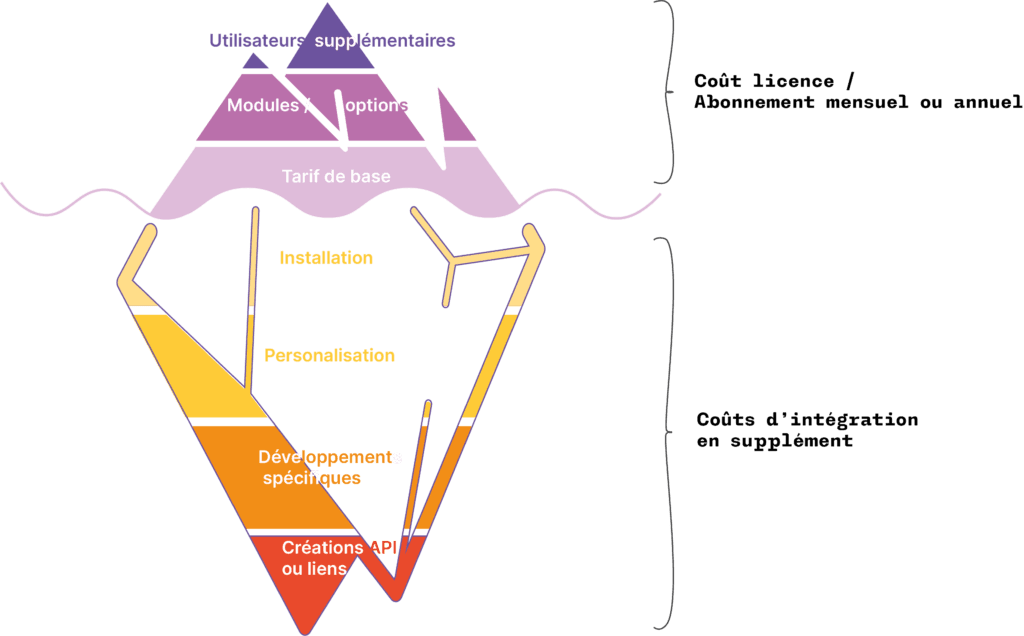
Generally, licenses are sold at several pricing levels, and in annual or monthly subscriptions from the publishers:
- A basic offer: with a more or less enticing price, depending on the robustness of the software and its features,
- Paid additional features,
- A rate set according to the number of users.
To these costs must be added integration fees: these are the costs to "install" and adapt the software to the company and to its tools already in place (often concerning accounting, payroll, etc...). Depending on the size of the company and the depth of features of the purchased software, these fees can be very high and even higher than the upfront cost of the license because they include development (customization and APIs towards other management software in particular).
Custom software, how much does it cost?
In the case of software specifically created for a company, the costs will essentially be linked to development: depending on the provider you choose, and the technicality of the expected final product, the final cost may vary from a few thousand to several tens of thousands of euros.
To these development costs may be added possible maintenance fees, or simply hosting of your software.
But if your needs are well calibrated with the right developer, these costs will be a real long-term investment for your company!
Choosing the right developer isn't so simple, but you'll find some practical advice over here!
The cost assessment: custom software VS ready-made license
Even if upfront, the subscription costs of a license may seem lower than the development costs of a custom digital tool, you have to think about all the costs that could be added to it.
License costs are often presented in the form of a subscription: you therefore have to fully measure the accumulation of monthly payments paid as long as the software is used, in order to compare with development costs.
What are the advantages of custom software?
The subject of price having been addressed, it remains to know how custom-developed digital tools differ from already existing products!
Perfectly adapted tools
And yes, no surprise, custom software will necessarily be more adapted than an already-ready product... You didn't need us to know that! But beyond this evidence, what are the concrete impacts for the company?
- Avoid accumulations and duplications of tools: with custom-created software, one of the advantages is to be able to group together needs that are usually handled through several specialized tools. Rather than considering API developments in order to make existing software communicate with each other, which also requires a significant development budget, why not opt for the complete creation of your own system?
- Save time: a tool closely matching the company's needs will make it possible to carry out various tasks more efficiently, without wasted time.
- Generate stronger buy-in: from internal teams, whose work will be facilitated by a more suitable tool. But also externally: a custom-made tool can also give a better image of the company vis-à-vis its clients and partners.
More profitable business software
Although custom development in principle represents a higher initial expense, it quickly becomes more profitable.
- ROI: when a company makes an expenditure, it expects a return on investment. It can be a time saving, an improvement in productivity, etc... The more suitable the tool, the more effective these gains are for the company!
- Speaking of gains, we can also talk about valuation. When a company has a custom digital tool developed, it is an investment, which will appear as an asset of the company, and which will increase its book value.
- Beyond this book value, a company with modern and structuring tools will also have much more "market" value in the eyes of potential investors or buyers: moreover, data is today an ultra-strategic element, and one that can be worth a lot!
Scalable and durable tools
One of the main advantages of custom software is being entirely optimizable and adjustable according to your needs. Custom-developed software is designed to be easily modifiable and extensible, which makes it a scalable tool. New features can be added, and processes adjusted, without having to suffer the constraints of a proprietary license.
In short, you have a solution that adapts, where standard software often requires compromises on needs or costly upgrades, or even software changes, which are always very restrictive.
Better managed data
Custom software allows total control over company data and the way it is managed. Specific security measures can be integrated, where standard software follows generic and sometimes insufficient standards.
To sum up
Custom software development is still rarely considered by medium-sized companies, for reasons of apparent costs. However, having your own tool developed offers many advantages:
- Increase in internal performance thanks to a tool adapted to the specific needs of the company,
- Increase in profitability,
- Better control over company data,
- Gain in agility with a tool guaranteeing scalability and a lasting return on investment,
- Improvement of the company's image internally and externally,
- Better valuation of the company...
And the icing on the cake:
Even if the initial cost of custom development may seem high, there are recent development technologies that save time and are therefore much more economical for equal performance: this is LOW CODE, which we advocate at JUNR in order to offer the most efficient custom-made tools, in much shorter timeframes and for more reasonable budgets.
To learn more and better find your way in the digital "jungle", we tell you more in our article dedicated to low code VS other development techniques.
Ready to reap the benefits of a tailor-made digital solution, built 4x faster, 3x cheaper, 12x more profitable


