

Created on:
Modified on :
Application development time: how to choose the fastest and most suitable solution?

Written by :
Boris
Whether it's a web or mobile application, the question of an application's development time comes up often. And for good reason! An application's development time is generally directly correlated to its price.
However, the answer is relatively complex because an application's development time depends on multiple factors: complexity of the need, technologies used, development methodology... We will nevertheless try to shed as much light as possible so that you can make the right choices in developing your application.
In any case, we are going to compare the techniques that are more or less fast on a relative basis, and we can hardly give numerical indications as this can vary greatly from one project to another.
Depending on the complexity of the need
This is probably the most complex part to approach for someone starting out in developing an application: what is complex and what isn't? In the wonderful world of developers, complexity rarely hides where you expect it. It is therefore almost impossible for a newcomer to estimate the complexity of a project without discussing it with a development team.
The only advice we can give here is to talk quickly with experts to determine how complex the features you are thinking of are to develop, or not. You may realize that the ones that seem the craziest to you are actually simple, and that very small features with little importance are very complex. You will thus be able to make trade-offs very early in your process on which ones you will ultimately commit to.
Furthermore, at equal complexity, the provider you are going to choose will have a great impact on an application's development time.
Depending on the type of provider
Whether you decide to go it alone, or to hire an army of developers, an application's development time will be strongly impacted, as well as its cost.
Without a provider
You've decided to go it alone 🤪, let's see how that can turn out!
You are a developer
Congratulations, you know what you're talking about and don't need anyone. 🤠
But that's not the case for everyone!
You are not a developer
In that case, it's time to roll up your sleeves! 😼
Several solutions are available to you, overall all on no-code technologies, that is to say not requiring code in developing an application. We can cite:
- Mobile application development
- Web application development
At Junr, we think these solutions can be good for developing an application, provided you are vigilant on a few points:
- It's OK if you're a business owner, manager, or employee, and you're creating an application for yourself. It's NOT OK if an agency offers you a service through these tools: these are not professional tools, these are tools for newcomers with one-off needs. Would you feel confident if a 3-star chef explained to you that a Campingaz stove is what's best for doing fine cuisine? 🙄
- A developer's main quality is not to write lines of code, but to solve problems while understanding how the machine expresses and reacts. Even if you use no-code technologies, you must have a grounding in these subjects, as well as in software architecture.
- You certainly won't own the code generated by this tool (with rare exceptions). If one day you want to migrate to another (and you will, trust us 🫣), you'll have to start over from scratch.
- You will quickly encounter a technical limit: a feature you won't be able to create, tinkering to get to your goals, and this is not sustainable over time in the development of a scalable application.
- You will accumulate technical debt aka. lost investments the day you have to migrate to other solutions.
- You're going to spend time on it, a lot of time compared to a seasoned developer!
If you're OK with all these points, take the challenge! 🙏
With a freelancer
The advantage of the freelancer is the price! Well, that's the idea we have of the price...
Hiring a freelancer in a trade you don't master is always complicated. An application's development is often strategic at a given moment, so the risk of making the wrong choice is high.
Add to that the fact that a freelancer is always specialized, they will be fast in their field of expertise but very slow on all the little side tasks. This will increase the duration of the project, and, ultimately, cause higher costs.
With an agency
Unlike the freelancer, agencies seem expensive! But they go fast, very fast, in developing an application. Indeed, they combine a large workforce, cross-functional skills, and can therefore juggle with experts in each micro-domain of your application. Entrusting the development of an application to an agency is certainly the most rational choice, and ultimately the least costly in the long term.
This being said, the development duration is greatly impacted by the technologies that will be used, whether by you, your freelancer, or your agency!
Depending on the technologies used
We're going to get a little technical, and we're going to try to make it accessible!
Overall, there are several types of programming languages, and several ways to generate the code:
- Types of languages
- High level: these are languages relatively close to that of humans. They are therefore faster to implement.
- Low level: these are languages very close to machine language, they are therefore much more complex to understand and implement.
- Code generation
- Manual coding: each line of code is written by hand.
- Visual generation (No-Code): no line of code is written by hand.
- Mixed generation (Low Code): by hand we only write the lines that are specific use cases, we visually generate recurring processes (login, product display, etc.)
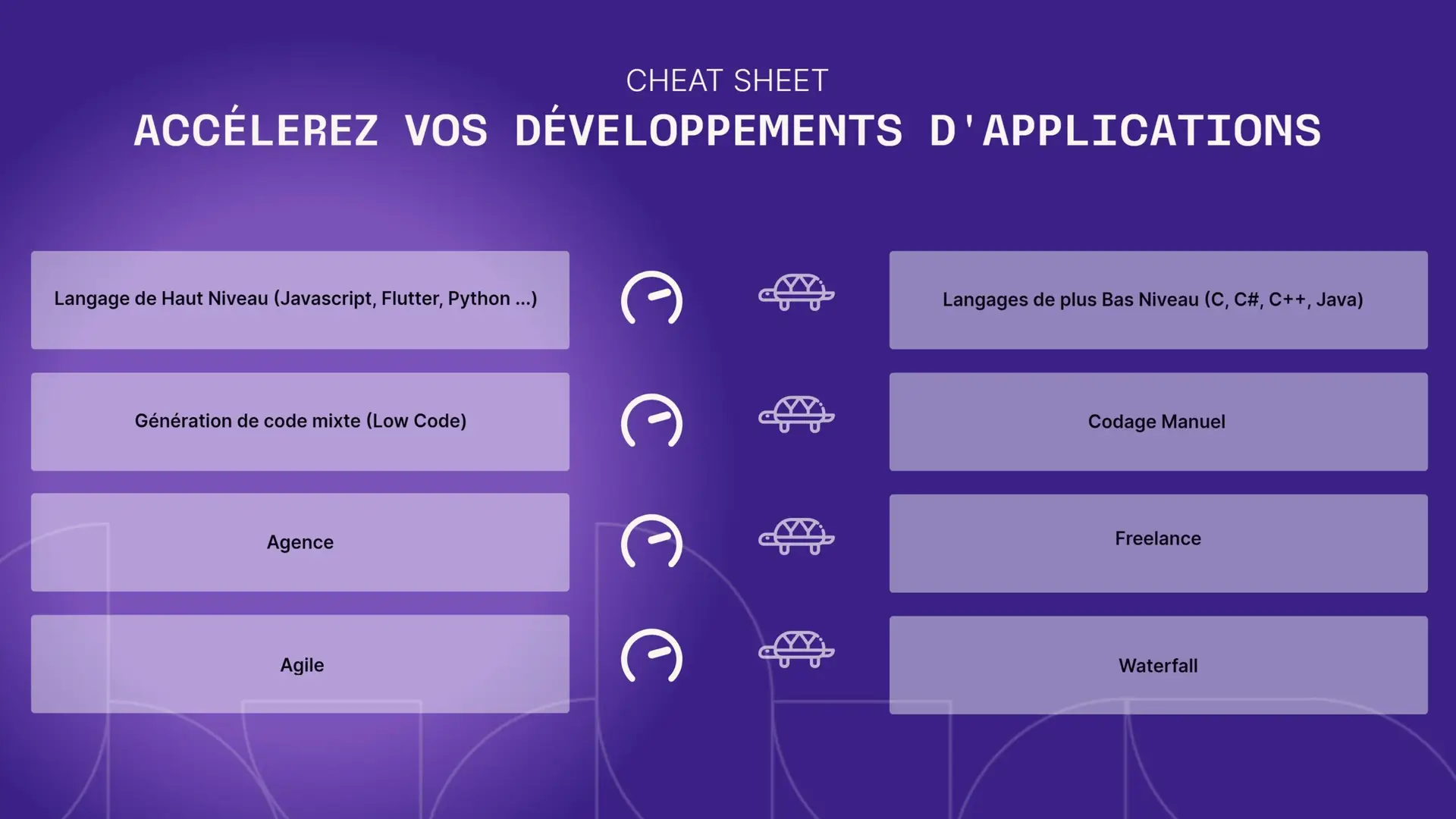
From there, as you will have understood, the fastest way in developing an application is to use high-level languages with visual generation. However, as seen previously, since No-Code has very heavy limitations, we will favor mixed generation (Low Code).
We have, incidentally, already written a Low-Code vs. No-Code article here.
We now have a good trio taking shape to accentuate the speed of developing an application: an agency, using High Level languages in Low Code. But again, there remains a margin for optimizing development time: the methodology.
Depending on the development methodology
There are two main methods of technological project management: Agile and Waterfall.
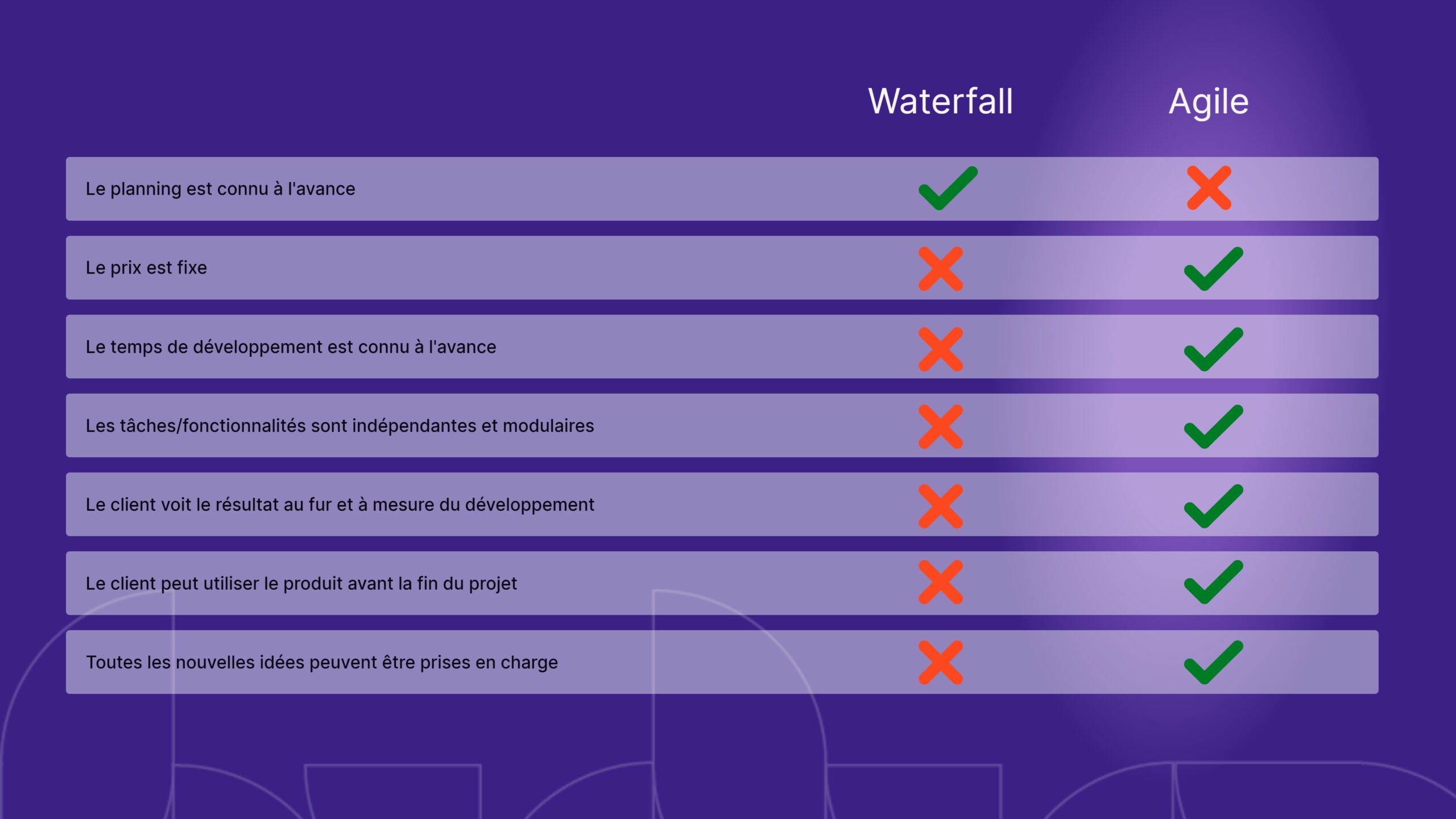
Waterfall allows you to have a clear vision of the execution plan for developing an application. That seems ideal, whereas in reality it is going to generate rigidity in your project. It will be very complicated to modify the plan along the way, which is however the wish of 99% of project owners 🤣. It's normal. That's actually why Agile was created!
Conversely, Agile promises you a budget and a timeline. You can change the plan whenever you want, adding and removing features compared to what you had initially planned, or stay within the same plan if it suits throughout (that never happens 🫢). In any case this agility allows you to maximize efficiency toward your application target, and therefore to reduce its development time. In addition, you have intermediate deliveries at each sprint, which allows you to launch a beta version of your application from the very first days of development.
We have written an article to explain to you all the ins and outs of good Agile project management, here's a small preview:
You can read the full article (we obviously recommend it 🤐) here.
Conclusion
Here's a little recap of our discussion, keep it preciously, it's your passport to efficiency in developing an application!
If you want to discuss your digital tool development project, it's this way!
Ready to reap the benefits of a tailor-made digital solution, built 4x faster, 3x cheaper, 12x more profitable


